Traditional Napa Cabbage Kimchi for Gut Health
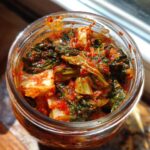
Make authentic, crunchy, and spicy fermented kimchi at home to support your gut health with this straightforward recipe.
- Prep Time: 45 min
- Cook Time: 5 min
- Total Time: 50 min
- Yield: About 2 quarts 1x
- Category: Side Dish
- Method: Fermentation
- Cuisine: Korean
- Diet: Vegetarian
Ingredients
Scale
- 5 lbs Napa cabbage
- 1 cup coarse sea salt
- 1/2 cup Korean chili flakes (gochugaru)
- 1/4 cup fish sauce
- 2 tablespoons salted fermented shrimp (saeujeot)
- 1/4 cup minced garlic
- 1 tablespoon minced ginger
- 1 small Asian pear, grated
- 1/2 cup sweet rice flour
- 1 cup water
- 1/2 cup radish, julienned
- 1 cup scallions, cut into 1-inch pieces
Instructions
- Cut the Napa cabbage lengthwise into quarters, then chop into 2-inch pieces.
- In a large bowl, toss the cabbage with the sea salt. Let it sit for 2 to 3 hours, turning every 30 minutes until the cabbage wilts and releases liquid.
- Rinse the salted cabbage thoroughly under cold running water three times to remove excess salt. Drain well in a colander for 30 minutes.
- Make the porridge: Whisk the sweet rice flour and water in a small saucepan over medium heat until it thickens into a paste. Remove from heat and let it cool completely.
- In a separate bowl, combine the cooled rice porridge, gochugaru, fish sauce, saeujeot, garlic, ginger, and grated Asian pear. Mix well to form the kimchi paste.
- In a very large bowl, combine the drained cabbage, julienned radish, and scallions with the kimchi paste. Use your hands (wear gloves) to massage the paste evenly into all the cabbage pieces.
- Pack the kimchi tightly into clean, sterilized glass jars, leaving at least 1 inch of headspace at the top. Press down to release any trapped air bubbles.
- Seal the jars loosely for the first 24 hours to allow initial gas release. After 24 hours, seal tightly and leave at room temperature for 1 to 3 days for initial fermentation, depending on your room temperature.
- Transfer the jars to the refrigerator to slow the fermentation process. Your probiotic food aesthetic is ready to enjoy after at least one week in the fridge.
Notes
- For a vegan version, substitute the fish sauce and salted shrimp with an equal amount of soy sauce and extra salt.
- If you prefer a milder flavor, reduce the amount of gochugaru slightly.
- The fermentation time at room temperature directly affects the sourness; taste daily after day one.
Nutrition
- Serving Size: 1/2 cup
- Calories: 45
- Sugar: 3
- Sodium: 450
- Fat: 0.5
- Saturated Fat: 0.1
- Unsaturated Fat: 0.4
- Trans Fat: 0
- Carbohydrates: 9
- Fiber: 2
- Protein: 2
- Cholesterol: 5